Paving the Pathway for Disability-Inclusive Education in Mozambique
Disability-inclusive education in Mozambique is not a marginal issue—it is a systems challenge with national implications. This article explores the structural barriers facing learners with disabilities and outlines a practical, scalable pathway for embedding inclusion into education policy, school design, teacher capability, and community engagement. Moving beyond goodwill and pilot projects, it argues for inclusion as a measurable development standard and a strategic investment in Mozambique’s human capital.
EDUCATION POLICY & SOCIAL INCLUSION
12/26/20253 min read
Disability-inclusive education is not a “special programme” at the edge of the system. It is the test of whether the system works at all.
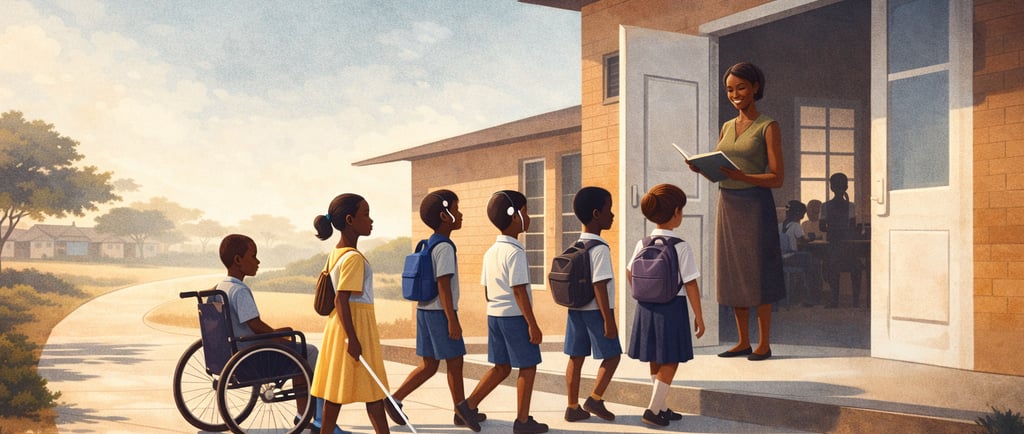
In Mozambique, thousands of children with disabilities still face barriers that are not caused by disability itself, but by environment: inaccessible classrooms, underprepared teachers, inconsistent screening and referral, limited learning materials, stigma, and long travel distances to schools that are not designed for inclusion. When these barriers pile up, the outcome is predictable—late enrolment, poor attendance, drop-out, and lifelong exclusion from opportunity.
If Mozambique is serious about human capital development, inclusive education must shift from being a well-meaning aspiration to being a measurable operational standard.
Why disability-inclusive education is a national development strategy
Education drives employment, health outcomes, civic participation, and long-term productivity. When children with disabilities are excluded, the country pays twice:
first, through underutilised talent and increased dependency,
and again through avoidable social costs (health complications, poverty cycles, and reduced community resilience).
Inclusive education is therefore not charity. It is basic national capacity building—unlocking learners who have been structurally locked out.
The real barriers are systemic, not personal
A disability-inclusive pathway must start by admitting a hard truth: the main barriers are rarely inside the learner. They sit in the system.
Common barriers include:
Physical access barriers: steps, narrow doors, inaccessible toilets, uneven grounds.
Learning access barriers: lack of braille/large print, limited sign language support, no assistive devices, poor acoustics, crowded classrooms.
Capability barriers: teachers trained to teach “one type of learner,” with limited inclusive pedagogy and classroom adaptation skills.
Identification barriers: late or inconsistent screening for vision, hearing, learning difficulties, and developmental delays.
Social barriers: stigma, bullying, and low expectations—sometimes reinforced unintentionally by adults.
Data barriers: weak disability-disaggregated education data, making planning and budgeting guesswork.
If we want different outcomes, we need different design.
A practical pathway: 8 building blocks Mozambique can implement
Below is a pragmatic blueprint that can work in rural and urban settings, and it scales when budgets are tight.
1) Make inclusion a standard, not a “pilot”
Pilot projects are helpful—but Mozambique needs a system rule: inclusion is the default expectation in every school, not a “special district” initiative.
What this looks like in practice:
school improvement plans must include inclusion indicators,
district education offices track inclusive access the same way they track enrolment.
2) Strengthen early identification and referral
Children cannot access support if nobody identifies their needs early.
Practical moves:
school-based screening days (vision, hearing, mobility, learning),
referral pathways linking schools to health and social services,
simple teacher checklists for early flags (not for diagnosis—just early action).
3) Train teachers for inclusive pedagogy (not just awareness)
Awareness workshops are nice. Skills training changes classrooms.
High-impact training topics:
differentiated instruction (teach the same lesson in multiple ways),
classroom accommodations (seating, pacing, scaffolding),
low-cost teaching aids and peer-learning models,
inclusive assessment methods.
If teacher training is the engine, coaching is the fuel. Mozambique should prioritise in-class coaching over once-off seminars.
4) Improve accessibility through “minimum viable infrastructure”
Not every school can be fully redesigned overnight. But every school can reach a minimum standard.
Minimum viable accessibility upgrades:
simple ramps and handrails,
widened doorways where possible,
accessible toilet solutions (even if basic),
safe walkways and classroom seating plans.
This is the unglamorous work that changes attendance.
5) Ensure learning materials and assistive support are available
Inclusion collapses when learners cannot access the curriculum.
Practical supports:
large-print materials, tactile aids, audio learning options,
sign language support where feasible (even community-based),
assistive device partnerships (NGOs, donor programmes, local fabrication where possible).
6) Use community partnerships to reduce stigma and keep children in school
Parents and communities are not “stakeholders.” They are co-owners of outcomes.
High-leverage interventions:
parent support circles,
community champions (including disabled role models),
anti-bullying culture campaigns led by learners,
school-community attendance tracking for at-risk learners.
7) Fund inclusion through predictable budgeting
The fastest way to kill inclusion is to fund it as an afterthought.
Mozambique can:
ring-fence a small percentage for inclusive education within district budgets,
define a per-learner support model (even if modest),
reduce “project dependency” by integrating inclusion into core spending lines.
8) Measure what matters: inclusion outcomes, not just inputs
Counting ramps and workshops is not enough.
Track outcomes like:
enrolment and attendance of learners with disabilities,
progression rates (do learners move up grades?),
learning achievement (adapted assessment where needed),
reduction in dropout,
teacher capability indicators (observed practice, not certificates).
What gets measured gets protected.
What success can look like in Mozambique
A disability-inclusive education pathway is successful when:
a child with a disability can enrol without negotiation,
a teacher can adapt instruction without panic,
a school can access referral support without bureaucracy,
parents feel respected and informed,
learners are safe from stigma and bullying,
data tells the truth—so planning improves every year.
That is not a dream. It is a design decision.
The strategic choice Mozambique must make
Mozambique can either treat inclusive education as a side programme—or as the backbone of equity, skills development, and national resilience.
If we choose the second option, the question becomes simple:
Will we keep building schools that some children cannot enter—
or will we build a system where every child can learn?
Get in touch
Newmarket, Suffolk (UK)
UK-wide & international support (including Zimbabwe)
Online & in-person (The Racing Centre)
Contact
info@echoesofability.org